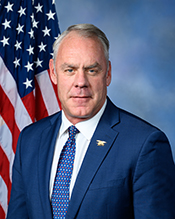
Rep. Ryan Zinke (R-Mont.) introduced legislation on June 10 to renew and update one of the signature conservation measures of President Trump’s first term, drawing bipartisan support from the chairman and ranking member of the House Natural Resources Committee.
A Follow-Up to a Trump-Era Conservation Law
The bill, known as GAOA 250, would reauthorize and modernize the original Great American Outdoors Act, which Trump signed into law in 2020. Zinke played a central role in building the original legislation during his tenure as the 52nd Secretary of the Interior, and is now leading the push to extend its reach into a second generation of funding.
House Natural Resources Committee Chairman Bruce Westerman (R-Ark.) and Ranking Member Jared Huffman (D-Calif.) both joined as co-introducers — an unusual show of bipartisan alignment on a natural resources bill. The measure has been referred to the House Natural Resources Committee for consideration.
What the Bill Would Do
GAOA 250 would commit $1.9 billion across five years to address deferred maintenance at national parks and public lands managed by federal agencies. The funding would draw from foreign visitor fees, private donations, and revenues generated by onshore energy development — rather than from general appropriations.
The bill also establishes a new fund called America’s Legacy Restoration Fund and formally codifies the Trump administration’s policy of charging fees to foreign visitors at federal lands. Those provisions are designed to ensure a stable, long-term revenue stream without relying solely on congressional appropriations cycles.
Proponents say the investment would support an estimated 72,500 jobs nationally and generate roughly $26.4 billion in economic activity for rural communities near federal lands — the gateway towns that depend heavily on outdoor tourism.
Montana’s Stake in the Program
Montana has seen significant returns from the original GAOA since its 2020 enactment, receiving more than $100 million in infrastructure improvements across public lands in the state. That figure covers projects spread across the National Park Service, U.S. Forest Service, Bureau of Land Management, Fish and Wildlife Service, and Bureau of Indian Education — agencies that collectively manage a large share of Montana’s land base.
The outdoor recreation economy nationally is valued at approximately $1.3 trillion, making conservation infrastructure an economic issue as much as an environmental one. For a state like Montana, where public lands drive tourism, recreation, and jobs in rural communities, the practical stakes of the reauthorization are substantial.
Zinke argued that the original law demonstrated conservation efforts need not come at the cost of economic development. “The Great American Outdoors Act was one of the crowning achievements of President Trump’s first administration and proved that conservation and economic growth can go hand in hand,” he said.
What Comes Next
With the bill now before the House Natural Resources Committee — the panel whose chairman co-introduced it — the legislation is positioned for an early hearing. Whether it can move through a crowded legislative calendar before the November general election remains to be seen.
Zinke faces his own reelection race this cycle, and his authorship of a high-profile, bipartisan conservation bill gives him a tangible accomplishment to bring back to Montana voters. The state’s economy has been navigating a mixed picture in recent months — ranking among the top states nationally for new business conditions while some key industries, including mining, work through slower recoveries from earlier downturns.
Conservation funding and public lands access consistently rank as top-tier issues for Montana voters across the political spectrum, giving GAOA 250 potential cross-party appeal even as its specifics work through the committee process in Washington.