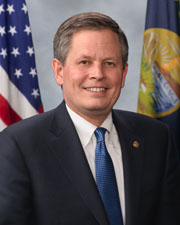
Montana Senator Steve Daines stepped before a Washington foreign policy audience on Wednesday to argue that the United States has a rare and closing window to build lasting partnerships across Central Asia and the South Caucasus — regions he says are now more strategically aligned with American interests than at any point in recent memory.
Daines delivered his remarks at the Trans-Caspian Forum hosted by the Caspian Policy Center in Washington, D.C., on June 11, drawing on firsthand diplomatic experience that few sitting senators can claim. In 2024, he became the first U.S. senator in more than a decade to visit all five Central Asian nations — Kazakhstan, Uzbekistan, Tajikistan, Turkmenistan, and the Kyrgyz Republic — meeting with heads of state in each country during the trip.
A Diplomat’s Track Record
Daines has continued his engagement with the region beyond that tour. In May 2025, he traveled to the South Caucasus while Armenia and Azerbaijan were working through peace negotiations, sitting down with Azerbaijani President Ilham Aliyev and Armenian Prime Minister Nikol Pashinyan. The two countries subsequently signed a landmark peace agreement, a deal the Trump administration helped broker.
Daines also facilitated a C5+1 Summit — a diplomatic format that brings together the United States and the five Central Asian republics — in Washington, reinforcing what he described as an emerging architecture of U.S. engagement with the broader region.
Strategic Stakes
At the core of Daines’ argument is the idea that Washington repeatedly failed to translate military cooperation — particularly during the Iraq and Afghanistan conflicts — into durable civilian and economic relationships with neighboring states. He pointed to Russia’s long-standing efforts to foment instability among regional governments as a way to preserve Moscow’s dominance, framing closer U.S. ties as both a geopolitical and commercial necessity.
The partnership areas Daines highlighted span critical minerals, rare earth supply chains, energy, telecommunications, agriculture, and both digital and physical infrastructure — sectors where American companies and the Central Asian economies share potential common ground. For a state like Montana, where the Stillwater Mine has been rebuilding its workforce after significant layoffs and where critical minerals remain central to economic conversations, the senator’s emphasis on rare earths and mining partnerships carries direct relevance.
“The United States, Central Asia, and the Caucasus are at last strategically aligned,” Daines told the forum audience. He framed the moment not as an opportunity to be weighed but as an obligation: “Building closer relations between our countries is not simply desirable but is a strategic imperative.”
Broader Context
Central Asia has received growing attention from American policymakers as China and Russia compete for influence across the region. The five former Soviet republics — sometimes collectively called the C5 — sit atop significant reserves of natural resources, including uranium, copper, and rare earth elements critical to American manufacturing and defense supply chains. Their geographic position between Russia, China, Iran, and Afghanistan also gives them considerable strategic weight.
Daines’ push for engagement fits within a broader Republican foreign policy posture under the Trump administration: skepticism of prolonged military entanglements abroad paired with an emphasis on economic competition with China and commercial diplomacy. The senator has used his seat on the Senate Foreign Relations Committee to press for greater American presence in regions where Beijing has been expanding its footprint.
Montana’s economy, which has drawn national notice recently — the state ranked among the top twelve nationally for new business conditions in a recent study — is itself increasingly linked to the kinds of supply-chain and energy partnerships Daines outlined at the forum.
No specific legislation was announced in conjunction with the senator’s remarks. Daines’ office has not indicated whether further travel to the region is planned, though his appearance at the Caspian Policy Center suggests the issue will remain a priority heading into the second half of 2026.